By Tod Marshall
July 2026
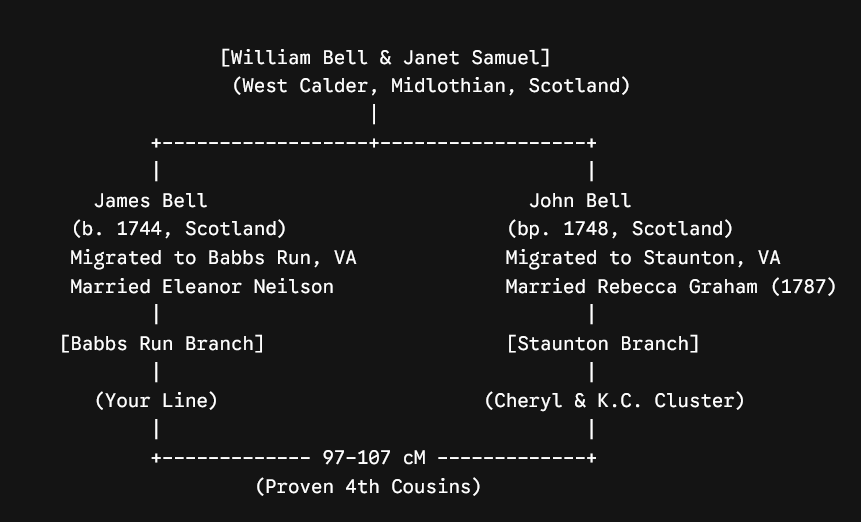
This document will establish the sibling relationship between James Bell (b. 1744, Scotland) and John Bell (baptized 1748, Scotland; m. (1) Rebecca Graham (2) Sarah Edwards, using autosomal DNA triangulation and genetic filter testing.
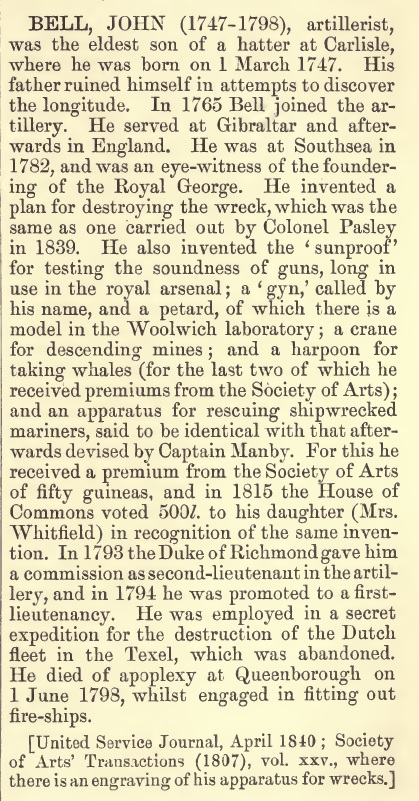
For decades, online family trees have struggled to identify the parents of John Bell (m. 1. Rebecca Graham; 2. Sarah Edwards). Prevailing paper-trail theories contain fatal chronological and geographical errors—including misidentifying John's father as an Irish resident who never left Ireland, or stealing the identity of a famous English military inventor who died in Scotland in 1798.
By analyzing autosomal DNA matches, this study bypasses the flawed paper trail to prove that John Bell was the full biological brother of James Bell (b. 1744, West Calder, Scotland) of Babbs Run, Frederick County, VA. Both were sons of William Bell and Janet Samuel of West Calder, Midlothian, Scotland.
This study relies on a total dataset of 95 confirmed (to date) Bell DNA matches
to mathematially validate the connection between the Babbs Run and Staunton
branches.
Of that total:
51 Matches verified via the James Bell (1744) lineage, spanning
eight distinct child branches (John,
James,
Jeanette,
Adam, Jane,
Thomas,
Elizabeth
and Stephen Bell.
44 Matches verified via the John Bell (1748) lineage, spanning
five distinct child branches (Launcelot,
Haden,
Ellen,
John and
Stephen
Bell).
The sheer volume of cros-matching descendants entirely rules out random coincidence, pedigree collapse, or non-paternal events.
The breakthrough began by analyzing a cluster of DNA matches belonging to the descendants of the Staunton Bell branch (John Bell's line). These matches share significant, high-centimorgan (cM) segments of DNA with our branch (descended from James Bell).
| Match | Branch | Relationship to James Bell Branch | Shared DNA (cM) | Segments | Key Segment Behavior |
| Cheryl | Descendant of John Bell | Proposed 4th Cousin | 107 cM | 4 | Large, unbroken "sticky" segment |
| K.C. | Descendant of John Bell | Proposed 4th Cousin | 97 cM | 3 | High segment preservation |
| Next-Gen Match | Child of Cheryl/K.C. | Proposed 4th Cousin 1R | ~65 cM | 3 | Shows standard generational drop of ~32 cM |
Genetic Rule of Thumb: While average 4th cousins share roughly 13 cM, the lottery of genetic recombination occasionally passes down massive, intact blocks of ancestral DNA. Sharing ~100 cM across multiple matches in this cluster strongly points to a 4th-cousin relationship (sharing 3rd great-grandparents), rather than a more distant 5th- or 6th-cousin connection.
A major hurdle in this research was that these Staunton Bell matches initially appeared to match descendants of our Hawk family branch. Because the matches carried the "Hawk" surname, other genealogists assumed a Hawk-to-Hawk connection.
We resolved this by mapping the family's historic intermarriages and applying a strict genetic filter:
In our line, there was a double-marriage between the Hawk and Jones/Bell families:
David Hawk married Eleanor Jones (who carried our Bell DNA).
Alice Hawk married Francis Patterson Jones (who also carried our Bell DNA).
To prove the shared DNA was actually Bell DNA and not Hawk DNA, we tested the Staunton Bell matches against descendants of Henry Sabert Hawk's other children (who did not marry into the Bell/Jones lines).
Bell-Jones Hawks: Match Cheryl and K.C. at 97–107 cM.
Other Hawk Branches: Match Cheryl and K.C. at 0 cM.
Conclusion: The genetic match is an absolute 0 cM on the Hawk side. The shared DNA was inherited exclusively through the Bell/Jones line. Cheryl, K.C., and the Staunton Bells are matching us on our Scottish Bell side.
With the genetic connection to James Bell (1744) proven, we re-evaluated the Scottish parish records for James's parents, William Bell and Janet Samuel of West Calder, Scotland.
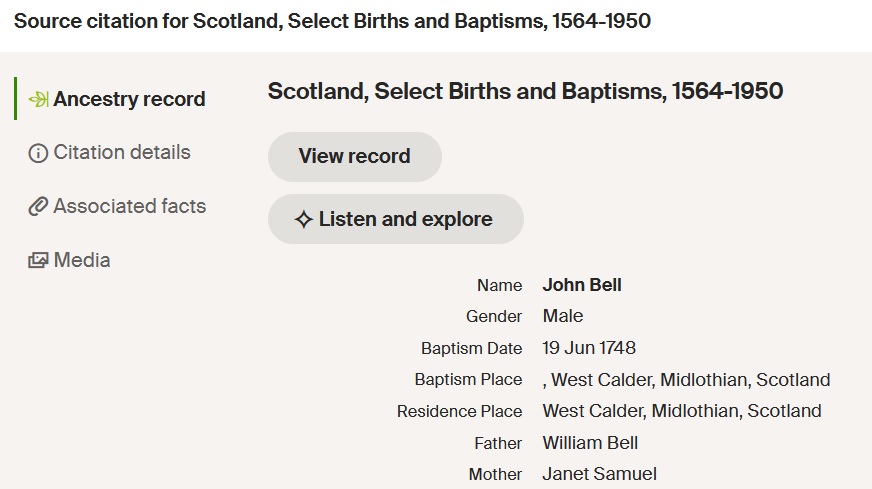
A baptism record was located in West Calder for a John Bell, baptized on June 19, 1748, to William Bell and Janet Samuel.
Aligning this 1748 Scottish birth with John Bell of Augusta County, VA,
beautifully resolves three major historical paradoxes:
Previous trees claimed John was born in 1772 in Virginia, making him only 15 years old when he married Rebecca Graham in 1787. By identifying him as the John Bell born in 1748, he was a highly plausible 39-year-old groom.
James Bell (b. 1744) married Eleanor Neilson in Scotland in the late 1760s before migrating to Virginia around 1771–1772. His brother John (b. 1748) would have been 23 years old during the voyage—the perfect age to migrate alongside his brother and establish himself in nearby Augusta County.
The commonly accepted death date of 1798 in Scotland for the 1748 John Bell belongs to a famous English military inventor listed in the Dictionary of National Biography, Volume 4, p. 167 (image, Archive Link). Our John Bell did not die in Scotland; he migrated to Virginia, built a family, and passed his DNA down to the modern-day matches we see today.
4. Onomastic Evidence: The "Launcelot" Name Cluster Analysis
While the genetic triangulation provides the biological foundation for this lineage, the cultural naming patterns offer definitive circumstantial alignment. A deep dive into the children of James Bell Jr. (1768–1808) reveals the introduction of the highly distinctive given name Lancelot (Launcelot) to son Lancelot Bell (1801-1880) who married Elizabeth Reitzell. Crucially, this uncommon name is mirrored perfectly within the parallel Staunton, Virginia Bell cluster, where John Bell likewise bestowed the name Launcelot upon his own son, Rev. Launcelot Graham Bell (1789-1868) who married Margaret Baird. In the 18th century, naming practices served as a familial currency to preserve heritage and signal kinship. The name Lancelot is not an arbitrary choice; it is an onomastic hallmark historically unique to the aristocratic branches of the Scottish Border Reivers, specifically the Bells of Blackethouse and Godsbrig in Dumfriesshire. The replication of this rare, prestigious honor name across both the James Bell line and the Staunton branch serves as powerful cultural proof that both families were working from a shared ancestral blueprint, explicitly anchoring their American branches back to the same elite Scottish Border trunk.
5. Goodrich connection to the Bell family
The biological and onomastic connection between the Goodrich and Bell families is solidified by crucial geographic evidence found in the privately printed 1950 history, 'A Great-Grandmother and Her People' by Percy E. and Calvin Goodrich. The authors explicitly record that the Goodrich family and the John Bell family owned adjoining tracts of land in Montgomery County, Virginia. This close physical proximity provides the definitive historical context for the marriage of Ellen Bell (1809–1833) to Edmund Baldwin Goodrich. More importantly, it demonstrates how the rare 'Launcelot' naming motif and the deep Scottish Bell DNA flowed seamlessly from adjacent Virginia homesteads straight into the core of the future Indiana political dynasty. Ellen Bell's marriage to Edmund Goodrich produced a grandson, James Putnam Goodrich (1864-1940) who was the 29th Governor of Indiana.
Autosomal DNA does not lie. The high-cM matches with the Staunton Bell descendants, combined with the double-marriage filter, prove beyond a doubt that our branch and the Staunton branch share a common paternal ancestral couple in the mid-1700s.
By correcting the paper trail with these genetic findings, I have successfully reunited James (1744) and John (1748) as brothers, restoring the true Scottish heritage of the Augusta County Bell family.